
Radiation saved your life.now we'll help your tissue recover.

Radiation therapy is powerful — and that power can affect tissue years after treatment ends. Late effects of radiation are one of the strongest indications for hyperbaric oxygen therapy. The cancer may be gone; the tissue can still be rebuilt.
with cancer each year
as part of treatment Citation pending
tissue effects Citation pending
What radiationleaves behind.
Radiation kills cancer by damaging DNA — but it also damages tiny blood vessels in the treatment field. Over months or years, that tissue can become starved for oxygen. That's where late radiation effects come from. And that's exactly what hyperbaric oxygen is built for.
Skin breakdown that won't heal
The skin in a previous radiation field can break down spontaneously, or fail to heal from a small injury. The wound looks ordinary; what's beneath it is anything but. Standard wound care often isn't enough.
Osteoradionecrosis
When radiation damages the blood supply to bone, the bone itself can break down — most commonly in the jaw after head and neck radiation, but possible anywhere bone was in the field. Painful. Persistent. Often needs both HBOT and surgery.
Cystitis, proctitis, fistula
Radiation can affect the bladder lining, the rectum, or surrounding structures. Bleeding, persistent inflammation, and painful tissue effects can show up months or years after treatment is complete — and respond well to HBOT in many cases.
Hyperbaric oxygen,with intention.
HBOT directly addresses what radiation took away — the small vessel network that brought oxygen to the tissue. In a pressurized chamber, your body absorbs many times the normal amount of oxygen, which travels into damaged tissue and stimulates new vessel growth there.
For radiation tissue injury, HBOT isn't a supportive therapy. It's the primary treatment.
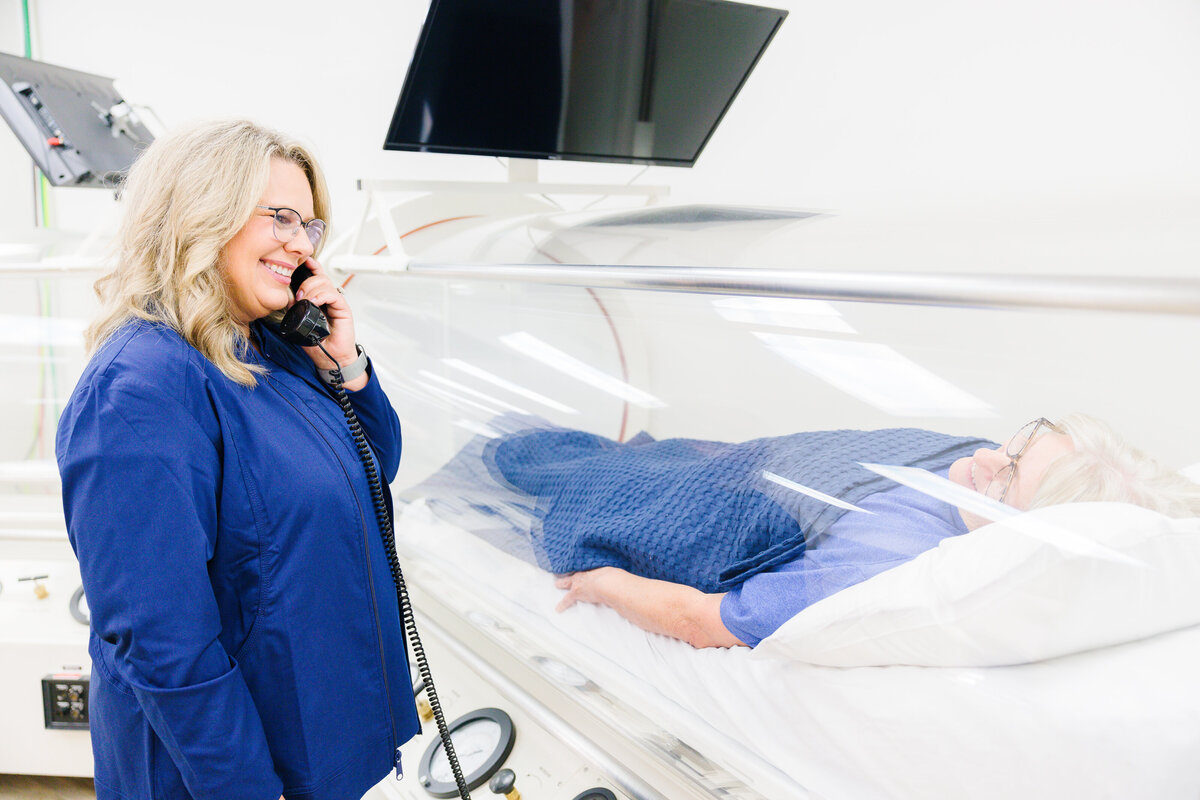
A typical course runs 30 to 60 daily sessions. Each session is about two hours, the chamber is pressurized to two-and-a-half atmospheres, and you breathe medical-grade oxygen the whole time. It's not uncomfortable — patients often read or watch a movie. The tissue change happens at the cellular level over weeks.
Many patients need HBOT before reconstruction surgery, to improve tissue quality enough for the surgery to succeed. Others need it after a wound or fistula has opened, to help close it. Some need it for an active issue like radiation cystitis. We'll know which fits at the first visit.
- Course of treatment typically 30–60 daily sessions, ~2 hours each
- Pre-surgical HBOT to improve tissue quality before reconstruction or graft
- Wound care alongside HBOT for tissue breakdown that's already there
- Coordination with your oncologist, surgeon, and primary care, so your plan stays aligned across the team
- Insurance coverage including Medicare, for qualifying indications
Before, during, after— it depends.
HBOT works on tissue that's been damaged for a long time. We've treated patients many years out from radiation. The timing of when to start depends on what you're dealing with.
Improve tissue oxygenation
If you need surgery in a previously-irradiated area — dental implants, breast reconstruction, jaw surgery, bowel reconstruction — pre-treatment HBOT raises the odds the surgery will hold. Typically a course before surgery, then more after.
Stimulate vessel growth
Radiation-induced wounds, fistulas, or active cystitis or proctitis often respond when HBOT is started. The damaged tissue is given the resources to repair itself.
Rebuild damaged tissue
Late radiation effects can show up many years after treatment — sometimes a decade or more. HBOT works on long-standing damage. It's not too late.
Late radiation effectsaren't always obvious.
If you've had radiation therapy in the past — recent or years ago — and you're seeing any of these, an HBOT consultation is worth the conversation.
- New skin breakdown in a previous radiation field
- Persistent bleeding from radiation cystitis or proctitis
- Bone exposure or non-healing fistula in a treated area
- Pain in a previously-treated area months or years later
- An upcoming surgery (dental implant, reconstruction) in an irradiated area
- Difficulty with skin graft or flap healing in a previous radiation field
Questions worth asking out loud.
Tap any question to expand. If yours isn't here, call us — we answer the phone.
How does hyperbaric oxygen help radiation injury?
Radiation damages tiny blood vessels in the treatment field. Over time, that tissue can become starved for oxygen and break down. HBOT delivers high concentrations of oxygen to damaged tissue under pressure, which stimulates new blood vessel growth (angiogenesis). Over a course of treatment, the affected tissue often becomes healthier — sometimes enough to heal a chronic wound or support reconstructive surgery that wasn't possible before.
How many HBOT sessions will I need?
A typical course for radiation tissue injury runs 30 to 60 daily sessions. Each session is about two hours. The number depends on what we're treating, how the tissue responds, and whether you're preparing for surgery or healing an active wound. We'll have a clearer answer after your first evaluation.
Is HBOT covered by insurance and Medicare?
Yes, for qualifying indications. Late effects of radiation, osteoradionecrosis, radiation cystitis, and several other conditions are covered by Medicare and major insurance. We'll verify your specific coverage before treatment begins.
Can I get HBOT years after my radiation treatment ended?
Yes. HBOT works on tissue that's been damaged for a long time. We've treated patients many years out from radiation. Late radiation effects can show up months or even decades after treatment — and HBOT can help even when the damage is long-standing. It's not too late.
Does HBOT have side effects?
HBOT is generally safe and well-tolerated. The most common side effect is ear pressure during compression and decompression, similar to flying. Less common: sinus discomfort, temporary nearsightedness with longer courses, and rarely oxygen toxicity. We review all of this in detail before treatment.
Is the chamber claustrophobic?
Our chambers are designed for comfort. Most patients listen to music, watch a movie, or read during sessions. If you're concerned about claustrophobia, tell us at your first visit — we can walk you through the chamber, talk through what to expect, and accommodate your needs.
Whatever stage you're at,
it's timeto make a plan.
Schedule a free 15-minute inquiry call. We'll listen, ask the right questions, and tell you honestly whether we're a fit. No pressure, no hour-long visit.