
Wounds
that won't heal
finally have somewhere to go.
For chronic, complex, and slow-healing wounds — diabetic ulcers, vascular wounds, surgical breakdowns, radiation injury, and beyond. A dedicated specialty practice that works alongside your existing care team. Specialized training. Coordinated care.
at intake
with a chronic wound
under one roof
plans accepted
specialty practice
The sooner we see it, the simpler it heals.earlier is easier.
The average wound we see at intake has been open for seven months. We can help at any stage — but the earlier a wound is referred, the faster and simpler the path tends to be. If something isn't closing, send it our way.
This is our specialty.with intention.
Wound care technology is always evolving. New, evidence-driven options keep emerging — but wound care isn't the focus at most clinics. The difference here is simple: it's our only focus, and that shows up in how you and your wound are cared for.
You may have been somewhere already. Maybe a primary care office that swapped your dressing every two weeks. Maybe an in-system wound clinic that scheduled you out a month. Maybe a surgeon who mentioned amputation a little too quickly. You're not alone in this — millions of people are living with wounds that won't heal, and many have been to a clinic that didn't have the time or the tools for what they needed.
At Midwest Hyperbarics, wound care is a dedicated specialty practice that works alongside the doctors already on your team. That means more time per visit, access to advanced therapies and on-site hyperbaric oxygen, and direct coordination with your existing care.
With the right plan, the right materials, and a provider paying close attention, most chronic wounds heal — even the ones that have been open a long time. We're your coach. You're the quarterback. And we work as a team.
Millions of Americans aren't healing.
Chronic, non-healing wounds aren't rare. They're a quiet epidemic — under-diagnosed, under-treated, and growing alongside diabetes, vascular disease, and an aging population. Every wound type below is one we treat.
Using oxygen to heal wounds isn't new.it's proven.
Hyperbaric oxygen has been developed, studied, and refined for treating wounds for more than half a century. Here's how the science arrived at your care.
The foundation
Dutch surgeons Boerema and Brummelkamp pioneer hyperbaric oxygen for infected and oxygen-starved tissue — the groundwork for treating wounds.
How it heals, understood
Research shows hyperbaric oxygen drives angiogenesis — new blood-vessel growth — and fuels the collagen and fibroblast activity a wound needs to close.
Tested on chronic wounds
Clinical studies on diabetic foot ulcers and radiation injury show HBOT raises tissue-oxygen levels and supports limb-saving outcomes.
Recognized indications
The UHMS and Medicare formally recognize specific wounds for HBOT — advanced diabetic foot ulcers, late radiation tissue injury, compromised grafts and flaps, refractory osteomyelitis.
Standardized, evidence-based care
Controlled trials and tools like transcutaneous oximetry refine who benefits most, establishing HBOT as a trusted part of comprehensive wound care.
Midwest Hyperbarics, Sioux Falls
This proven science delivered locally, in a medical-grade chamber — alongside the full range of advanced wound care, all under one roof.
If it won't close — bring it.
We treat a variety of wounds, including but not limited to the types below. Tap any to see how we approach it. Most are covered by Medicare and major insurance. Hyperbaric oxygen is added when clinically indicated.
01 Diabetic foot ulcers +
The single most common reason patients come to us — and the most preventable cause of amputation. Diabetic ulcers can be deceptive: they often look small, they don't always hurt, and they can deteriorate quickly when neuropathy and poor perfusion are involved.
We treat diabetic foot wounds across the full spectrum, from pre-ulcerative calluses to gangrene. Treatment is individualized — offloading, debridement, and dressing strategy chosen for where your wound is right now. Hyperbaric oxygen is added when wounds qualify (typically Wagner Grade 3 or 4).
- Treatment for diabetic foot wounds at every stage — from pre-ulcerative calluses through gangrene
- HBOT eligibility for qualifying Wagner Grade 3 or 4 wounds
- Close monitoring and follow-up scheduled to your individual needs
- Coordination with your care team — primary care, podiatry, vascular surgery, endocrinology, and beyond
02 Arterial & venous wounds +
Wounds caused by inadequate blood flow — peripheral artery disease — or chronic venous insufficiency are among the longest-running wound categories. Vascular wounds historically sustain a prolonged healing course. But with the right wound care product selection, individualized to your needs, vascular wounds can be healed and stay healed.
We work in lockstep with your vascular surgeon. Multilayer wraps with mild compression based on your vascular status, careful evaluation of perfusion, and referrals back to vascular for revascularization when needed.
- Follow-up schedule individualized to your specific needs
- Multilayer wraps with compression appropriate to your vascular status
- Wound care product selection chosen for your wound, not a default
- Coordination with vascular surgery for revascularization when indicated
03 Surgical wound dehiscence +
When a surgical incision opens or fails to heal as expected, ongoing wound management is a different specialty than the surgery itself. We provide that continuity — close monitoring, the right dressing or therapy at each visit, and direct communication with your surgical team so the plan stays aligned.
Negative-pressure therapy is one tool among many. The right choice for your wound depends on the wound, not a default protocol.
- Dressing and therapy selection chosen for your wound at each visit
- Negative-pressure wound therapy available when indicated
- Coordination with your surgical team to keep the post-op plan and wound plan aligned
- Specialty consults brought in for vascular, endocrine, ID, and beyond — when your case calls for it
04 Radiation tissue injury +
Late effects of radiation therapy — affecting soft tissue, bone, or surrounding structures — are one of the strongest indications for hyperbaric oxygen. We see these referrals from across the region, often from primary care, urology, general surgery, and gastroenterology, sometimes from the radiation team itself.
HBOT stimulates new vessel growth in the affected area, often dramatically improving tissue quality before further treatment or surgery.
- Individualized care based on the type and extent of radiation injury
- Hyperbaric oxygen therapy as the primary treatment when indicated
- Coordination with your full care team across specialties
- Insurance coverage including Medicare for qualifying indications
05 Pressure injuries +
We treat pressure injuries at every stage — from no open sore (Stage 1) to exposed bone (Stage 4) — including those that develop in long-term care or after extended hospitalization. Care includes careful staging, offloading, nutrition support, and the right dressing strategy for where the wound is.
For patients who qualify, we coordinate home health services. We collaborate with skilled nursing and family caregivers when appropriate to keep care consistent.
- Treatment at every pressure injury stage, from intact skin to exposed bone
- Offloading, nutrition support, and dressing selection for your wound
- Coordination of home health services when you meet eligibility
- Collaboration with skilled nursing and your existing care team
06 Compromised skin grafts & flaps +
When a graft or flap shows early signs of failure — discoloration, edge necrosis, slow take — early hyperbaric oxygen can rescue tissue that would otherwise need to be revised.
Time matters. We accept urgent referrals from plastic and reconstructive surgery teams.
- Same- or next-day urgency for graft and flap concerns
- Hyperbaric oxygen therapy when clinically indicated
- Direct collaboration with your care team and surgeon
- Insurance coverage for qualifying indications
07 Trauma & crush injuries +
Soft-tissue trauma that isn't healing on schedule — including crush injuries and compartment-related complications — benefits from advanced wound care alongside any orthopedic or surgical follow-up. Sometimes the wound is from trauma; sometimes there's an underlying vascular contributor. Either way, we work with your team.
- Wound care alongside your orthopedic or surgical recovery
- Hyperbaric oxygen therapy for acute crush injuries when indicated
- Collaboration with your current care team and surgeons
- Insurance coverage for qualifying indications
If a condition is part of the picture— start here.
Wounds rarely come from one cause. These pages dig into how diabetes, vascular disease, and cancer treatment affect healing — and what that means for your care.
Diabetes & Wound Healing
How diabetes affects healing — neuropathy, circulation, the daily things to watch for. The biggest patient population we see.
Vascular Disease & Wound Healing
Arterial vs. venous wounds — what's different, what each one tells us, and why the right compression decision matters so much.
Cancer & Wound Healing
Late radiation effects, osteoradionecrosis, and the role of hyperbaric oxygen — sometimes years after treatment ends.
Caring for Your Wound at Home
The 5-minute daily check, dressing care, nutrition, when to call us — practical home care that moves the needle between visits.
Three things we dodifferently.
Most patients tell us their first visit feels nothing like what they were used to. Here's why.
The time your wound needs.
You're not boxed into a standard 15-minute visit. Each case gets the time it actually needs — sometimes that's a thorough first evaluation, sometimes that's a quick, focused follow-up.
The plan adjusts as the wound does. When the case calls for more attention, you have more attention. When the wound is on the mend, we don't drag it out.
A small team that knows your whole case.
We're not a big-system shuffle of rotating providers and unfamiliar nurses. You'll work with a small, intimate team that knows your wound, your history, and what's been tried — and we prioritize seeing you with the same provider whenever scheduling makes it possible.
We don't just look at the hole — we look at the whole patient. Overall health, medications, nutrition, and what's been tried before all shape the plan.
Everyone you've asked us to involve stays in the loop.
We coordinate directly with your existing care team — vascular, primary care, podiatry, endocrinology, surgery — so nothing gets lost between visits. Open communication isn't a perk; it's how we keep your plan working.
We're your coach. You're the quarterback. The plan is yours — and the providers you've asked us to include are part of it.
You're not switching sides.you're adding a specialist.
The most common worry we hear: "Will my regular doctor be upset?" No. We work alongside your existing care team — they almost always welcome it.
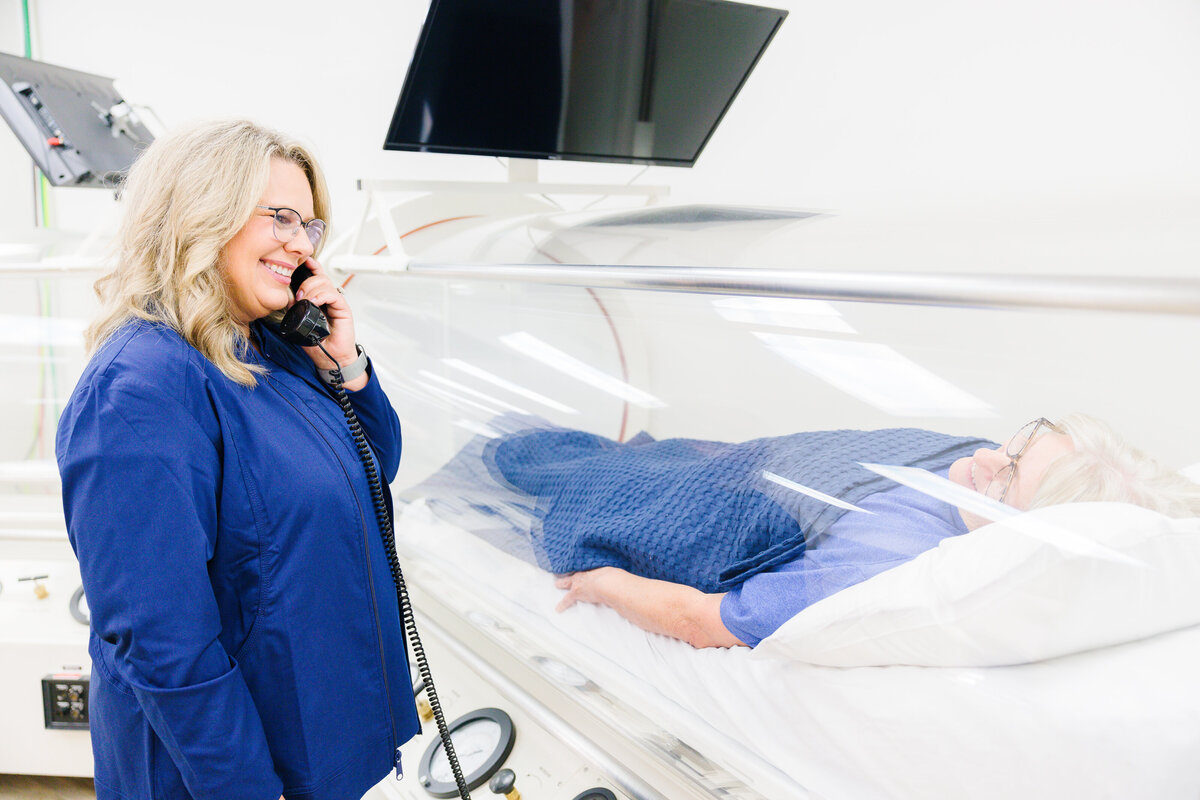
We collaborate.by default.
Most of our patients come from referrals — vascular surgeons, primary care providers, podiatrists, surgeons, and others across Sioux Falls and the region. The rest find us themselves. Either way, we treat your existing team as part of our team.
-
✓
We update your primary doctor Standard letters, fax, or chart-portal — whichever they accept.
-
✓
We talk directly to your specialists Vascular, plastics, surgical, endocrine — provider-to-provider phone calls when needed.
-
✓
Open lines of communication We keep the providers you've asked us to involve in the loop — because withholding information hurts the wound plan.
-
✓
We don't pull you out of their system Keep your primary, your endo, your surgeon. We add to their work — we don't replace it.
Wounds open 3, 5 yearsclosed.
Real outcomes from real patients in the practice. Names and photos used with written permission.
His wound is nearly healed. Three months in. The kind of progress you stop believing is possible after years of treatment that didn't move.
Infection to the bone, multiple complications. We're close. He says he isn't sure he wants the wound to close — he likes coming here too much.
I send my hardest patients here. Ones I couldn't move. They communicate, they document, and the wounds actually close.
Send the wound.we'll handle the rest.
You don't need a portal login. You don't need an EMR integration. Send a fax, a phone call, or a digital referral — whichever your office runs on. We confirm receipt the same day, see the patient typically within 5 business days, and report back routinely.
Questions worth asking out loud.
Tap any question to expand. If yours isn't here, call us — we answer the phone.
What conditions does Midwest Hyperbarics treat?
We treat a variety of chronic and complex wounds — including but not limited to diabetic foot ulcers, arterial and venous wounds, surgical wound dehiscence, radiation tissue injury, pressure injuries, compromised skin grafts and flaps, and trauma or crush injuries. We also provide hyperbaric oxygen therapy for qualifying indications.
Do I need a referral to make an appointment?
No. You can call us directly at 605-743-0402 to schedule a free 15-minute inquiry call. We work with referring providers when there's an existing care team, but we don't require a referral to start the conversation.
How is Midwest Hyperbarics different from a hospital wound care clinic?
We're a dedicated specialty practice that works alongside your existing care team. Wound care is our only focus, not one of many. That means more time per visit, a small team that knows your case, and direct coordination with the providers already involved — rather than handoffs between rotating staff.
Is hyperbaric oxygen therapy covered by insurance?
Yes, for qualifying indications. Medicare and major insurance cover HBOT for late effects of radiation, diabetic foot ulcers (Wagner Grade 3 or 4), osteoradionecrosis, compromised grafts and flaps, and several other approved conditions. We verify your specific coverage before treatment begins.
How quickly can I get an appointment?
Most new evaluations are scheduled within one to two weeks. For urgent referrals — compromised grafts, acute crush injuries, rapidly deteriorating wounds — we accept same-day or next-day appointments when clinically warranted.
Where are you located?
6300 S Lyncrest Ave, Sioux Falls, SD 57108. We see patients from across eastern South Dakota, southwestern Minnesota, and northwestern Iowa.
Whatever stage you're at,
it's timeto make a plan.
Schedule a free 15-minute inquiry call. We'll listen, ask the right questions, and tell you honestly whether we're a fit. No pressure, no hour-long visit.